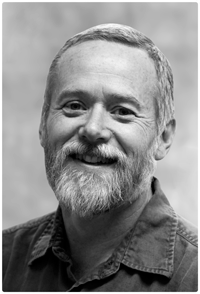
James M. Cribb
In the early 1970s I embraced the Bahá'í Faith and its teachings about the oneness of humanity. Its wisdom and perspective continue to guide my life and my work.
Later that decade I enrolled in university. I lasted one week. With the tuition refund I bought a Nikon F2 camera and some rolls of Kodachrome film, and set out to explore this sacred world.
What an odyssey it has been. And continues to be. Whether enchanted diving with hammerhead sharks in the Galapagos Islands or honoured sharing food with a native family in a remote village in India, I feel deeply connected with the life I photograph. The beauty, the joy, the hardship, the passion I observe through the lens, instill in me a profound sense of humility as I marvel at the unity of all creation.
I started writing to add context and storyline to photographs. Over time I came to appreciate the written word as I do the captured image; both foundational tools of expression. Sometimes photographs dominate (Treasures of the Sea: Marine Life of the Pacific Northwest), sometimes photographs and words share the stage (SUBTIDAL GALAPAGOS: Exploring the Waters of Darwin’s Islands), and sometimes, as with my latest project, words prevail (DEATH BY JOY: An Escorted Journey—companion book to the film).
I became interested in a third medium, film, for an historical project on the life of Mírzá Husayn-‘Alí, a nobleman in 19th century Persia better known by the formal designation Bahá’u’lláh. The feature-length documentary titled The Promise of All Ages details the extraordinary life of Bahá’u’lláh, Who founded the Bahá’í Faith, now the second most widespread religion in the world (source: Encyclopædia Britannica). I also chose film for the documentary version of DEATH BY JOY: An Escorted Journey, a candid story of one woman’s choice to find joy in dying and her unforgettable discoveries along the way.
I have released my latest book, DEATH BY JOY, companion to the film. The awareness that has dawned through the production of the film and the writing of this book has allowed me to view death in a light far brighter than the shadowed, grief-centric attitudes of Western society today. I continue to share—in rural community halls, city convention centres, and across the wide expanse of the Internet—how it is possible to stride joyfully along illumined pathways to embrace, not dread, dying, as is so movingly illustrated by Mary, the protagonist in the film and book.